Operations Manual
This document is to be abided by & referenced by all MODv pilots flying with MODv remarks on the VATSIM Network.
Version 1.5
Chapter 1 - Prologue
Ministry of Defence (UK) Virtual has been established to give VATSIM members the opportunity to be a part of a community focusing on flying realistic military operations within the United Kingdom (and British Overseas Territories), including the Royal Air Force, Royal Navy Fleet Air Arm, Army Air Corps and various MOD contractors (Draken etc).
Chapter 2 - General
2.1 Expectations
All members are expected to conform to high standards, as is customary for all VSOA pilots. We expect pilots to;
Act Professional - In order to maintain the integrity of the organisation and as not to reflect badly on the VSOD, we expect all pilots to be professional at all times, including in the discord and on the VATSIM network.
Maintain Realism - To ensure we provide the most realistic experience for pilots, controllers and other network users, pilots are expected to adhere to realistic practices.
Continue to Learn - Good pilots don’t stop learning, and it’s no different here. Pilots are expected to maintain a positive attitude to education.
Adapt - Pilots are expected to adapt to an ever changing environment, whether it be new tactics, new technology or new policy.
Have Fun - At the end of the day, MODv is a hobby, and should be treated as such. If we are unable to enjoy what we are doing, what’s the point? Whilst maintaining standards we expect all members to ensure we maintain a fun and welcoming environment.
2.2 Application Process
We welcome new pilots who wish to partake in our operations. Aspiring members are to fill out an application on our website (https://modvirtual.co.uk/) answering all questions thoroughly.
The follow prerequisites must also be met before applying;
- Be at least 16 years of age at the time of application
- Have at least 200 flying hours on the VATSIM network
- Have a basic understanding of how to operate an aircraft under visual & instrument flight rules within the United Kingdom
- Own a copy of X-Plane, Prepar3D or Microsoft Flight Simulator 2020/24 with access to at least one aircraft operated by MODv
- Have access to Discord
- Operate within the restrictions & parameters outlined in our Operations Manual*
- Have a base understanding of UK military flying procedures, phraseology & conduct
Any attempt to circumvent these restrictions, or lying on your application can result in your application being permanently denied.
2.3 Activity Requirements
Rated pilots (Flying Officers and above) are expected to remain active, to prevent skill fade and to ensure our VSOA status is maintained. We expect pilots to fly at least 5 hours every quarter.
Recruits (Pilot Officers) are expected to complete at least one training session within 30 days of being accepted into MODv.
Pilots unable to adhere to these requirements may apply for a leave of absence (LOA) by contacting a MODv admin.
2.4 Rank Structure
In order to ensure this organisation is run efficiently, and to recognise commitment from pilots, the following rank structure has been implemented;
Operations Administrator (ADM)
Operation Administrators are responsible for overseeing the day to day operations of MODv, completing audits and ensuring the group maintains compliance with the VSOA policies.
Group Captain (Gp Capt)
Group Captains are responsible for overseeing a fleet and/or station, monitoring training, mission profiles and flying standards. They make up the first rank of the administrative team.
Wing Commander (Wg Cmdr)
Wing Commanders are tasked with instructing pilots and are overseen by a Gp Capt. All Wg Cmdrs are selected by the administrative team.
Squadron Leader (Sqn Ldr)
The title of ‘Squadron Leader’ is awarded to a pilot who surpasses 250 hours. As a squadron leader, they are expected to take lead on sorties, assist newly trained pilots and alert the Wg Cmdr of any issues.
Flight Lieutenant (Flt Lt)
The title of ‘Flight Lieutenant’ is awarded to a pilot who surpassed 50 hours.
Flying Officer (Fg Off)
The rank of ‘Flying Officer’ is awarded to any pilot who completes basic training and is cleared to operate solo.
Pilot Officer (Plt Off)
The rank of ‘Pilot Officer’ is assigned to all recruits who are undergoing training and are not rated on any type.
2.4 Suspensions
MODv administration reserves the right to remove any user for any reason, including unprofessional conduct, failure to complete training, not adhering to flying standards etc. Suspensions can be appealed by contacting MODv administration.
2.5 Resignations
Members who wish to resign should contact a member of the MODv administrative team so we can manage our records.
Chapter 3 - Training
3.1 Scope
MODv will provide training for members to ensure they have the required skills and knowledge to operate effectively as a VSOA member. We put a big emphasis on self study and expect trainees to ask questions and read around the subject where required.
3.2 Training Structure
We have identified that not everyone has access to the traditional aircraft that MOD using for training, as such we have adopted the following training structure;
Each pilot will select an aircraft to train on and will follow the training guides for the fleet in which the chosen aircraft is a part of.
Each training guide covers basic handling, advanced navigation and operational procedures. Once the student has completed all exercises in the training guide with the instructor they will undergo a competency test before being signed off. Once signed off they may fly an aircraft within that fleet, except for the fast jet fleet.
Should a student want to fly another aircraft in a separate fleet, they must undergo a differences training with an instructor.
Chapter 4 - Operations
4.1 Operational Structure
MODv replicates a variety of operators, including the Royal Air Force (RAF), the Royal Navy Fleet Air Arm, the Army Air Corps (AAC) and various MOD contractors such as Draken and the Empire Test Pilots School. Trained pilots may partake in operations across all organisations once sufficiently trained.
4.2 Royal Air Force Operations
Undoubtedly the most famous operator of military aircraft in the UK, the Royal Air Force (RAF) is the primary defence force for the UK (and overseas territories) air and space. MODv simulates all RAF squadrons, each listed and kept up to date in the discord. RAF operations include reconnaissance (ISTAR), multi-role combat (due to the sensitive nature of real world conflicts and the VSOA PPM, MODv pilots are not permitted to simulate real world engagements), aerial refueling, transport and search and rescue.
4.3 Royal Navy Fleet Air Arm Operations
The Fleet Air Arm is the aviation component of the Royal Navy, operating a fleet of helicopters, fast jets and turboprop aircraft they are effectively able to secure the seas, fight adversaries and aid troops. All Naval Air Squadrons are simulated, each listed and kept up to date in the MODv discord.
4.4 Air Army Corps Operations
The Army Air Corps (AAC) makes up the aviation arm of the British Army. Flying is restricted to helicopters including the Apache attack helicopter, and the Wildcat reconnaissance helicopter. All AAC Regiments are simulated, each listed and kept up to date in the MODv discord.
4.5 MOD Contractors
MODv has elected to simulate a variety of MOD contractors in order to give pilots a larger selection and to aid in our other military operations. At present the following organisations are simulated; Fast Jet Operations at Leeming (Hawker Hunter Aviation and the QEAF Hawks), The Empire Test Pilots School 2Excel Aviations ‘Excalibur’ Testbed, Government/VIP transport, Draken, Air Tanker, Warton Military Flight Ops and the Lightning Test & Evaluation Squadron based with the USAF in Edwards AFB. All contractors are listed and kept up to date in the MODv discord.
4.6 Aircraft Substitutions
MODv recognises not all aircraft are available in the simulator. In order to keep aircraft accessible to all, the following aircraft substitutions are permitted;
-
Hawk T2 and Hawk T1
-
AS365 and H160
-
MQ9A/B and Elebit Hermes 900
-
Puma and Super Puma
-
EC35 and EC45
-
AW159 and AW139
-
Falcon 900 and Falcon 7X, 8X & 50
- Falcon 20 and CJ4 & Falcon 50
-
Wildcat and Lynx
- Grob Prefect and Diamond DA50, Marchetti & Tutor
- Merlin & MH60
4.7 Fleets & Ratings
MODv aircraft are split up into the following fleets,
Fast Jet (FJ) - EUFI, F35, TEX2, HAWK, L159, HUNT, PC21
Transport (TSP) - A400, A332, A21N, C17, F900, SC7
Reconnaissance (REC) - B350, R135, MQ-9A/B, BN2P/T, P8, E737, FA20
Helicopter (HEL) - H47, PUMA, H64, A109, A139, AS65, LYNX, EH10, AS50, EC35, EC45
Miscellaneous - SPIT, HURI, DC3, DHC1, LANC, G115, DA42, RJ70, RJ1H, B752, G12T, E50P, FA20
Note:
To fly an aircraft under the “Miscellaneous” fleet, you must first hold at least one of the following ratings;
Fast Jet,
Transport,
Reconnaissance.
MODv Operations Administrators reserve the right to revoke any members rating and/or mandate any MODv members to sit a revalidation of said rating if deemed necessary by display of negligence or misconduct by the pilot whilst flying on the network.
4.8 Fast Jet Rating
Due to the complexity & diversity of fast jet aircraft, Fast Jet training is NOT initially available to new MODv members. In order to begin your Fast Jet training you must hold at least one of the following ratings;
Transport,
Reconnaissance,
Helicopter.
MODv pilots will ONLY be eligible for Fast Jet training if they have displayed integrity & professionalism in their previous MODv flying.
Operations Administrators (ADM) reserve the right to offer exception to this rule if a member is able to display a sufficient level of prior experience, knowledge and professionalism.
4.9 Special Operations
Some permitted VSOA activities/operations require case by case approval by an Operations Administrator (ADM) before they’re permitted to be flown on the network. These activities include the following:
Low level flying,
Air to Air refueling*
Carrier Operations
Fast Jet QRA / Intercept Missions
*This includes receiving fuel as an aircraft capable to do so & giving fuel as an aircraft capable to do so. Voyager aircraft are permitted to fly within UK Air to Air Refueling Areas (AARA) for training and/or practice without prior approval during which, you are not permitted to allow other aircraft to join without prior approval.
Approval to conduct special operations may be given to pilots under training by Wing Commanders if needed for training.
To otherwise obtain approval, please contact an Operations Administrator via Discord.
4.10 Operational Remarks
All flights conducted in an MODv capacity will wear the following excerpt in their flight-plan remarks:
RMK/MODVIRTUAL.CO.UK MIL VSOA
All MODv training flights will include the following excerpt at the beginning of their flight-plan remarks:
STS/TRAINING
MODv flights that wish to operate within a danger area and/or AARA, will include the following excerpt at the beginning of their flight-plan remarks before the "STS/" excerpt if it is included.
These remarks must be worn in accordance with any activity activated via the VATSIM UK NOTAM forum.
OPERATING D###/AARA# ####Z - ####Z
- D### - Danger Area designation needed
- AARA# - Air to Air Refueling Area designation needed
- ##:##Z - Times in which the areas are needed | From - To
4.11 NOTAMs
We're able to 'NOTAM' Danger Area & Air to Air Refueling Area activation through official VATSIM channels. All relevant NOTAM's should be created using VATSIM's V-LARA platform.
A full guide on how to use V-LARA has been provided by VATSIM UK at the following link:
VATSIM UK V-LARA Guide
4.12 Historic Fleet
A historic fleet has been established consisting of iconic historic aircraft from across all operators. Pilots wishing to fly aircraft from the historic fleet must seek approval from the relevant authority. They must also hold the rank of at least Flt Lt and hold the equivalent modern rating (E.g transport rating to fly a C130-J).
All operations should be to the same standard of modern operations.
When flying aircraft from the historic fleet, you must append 'Historic' to the squadron in your remarks. For example; OPR/ROYAL AIR FORCE HISTORIC 32 SQN SER/ZE700 RTF/Northolt RMK/MODVIRTUAL.CO.UK MIL VSOA
4.13 PIREPS
All flights conducted on the VATSIM network in a Ministry of Defence Virtual capacity are to be logged via PIREP on the MODv PMC.
Flights not conducted on the VATSIM network are NOT permitted to be logged via PIREP.
The information that should be provided on a PIREP is as shown below;
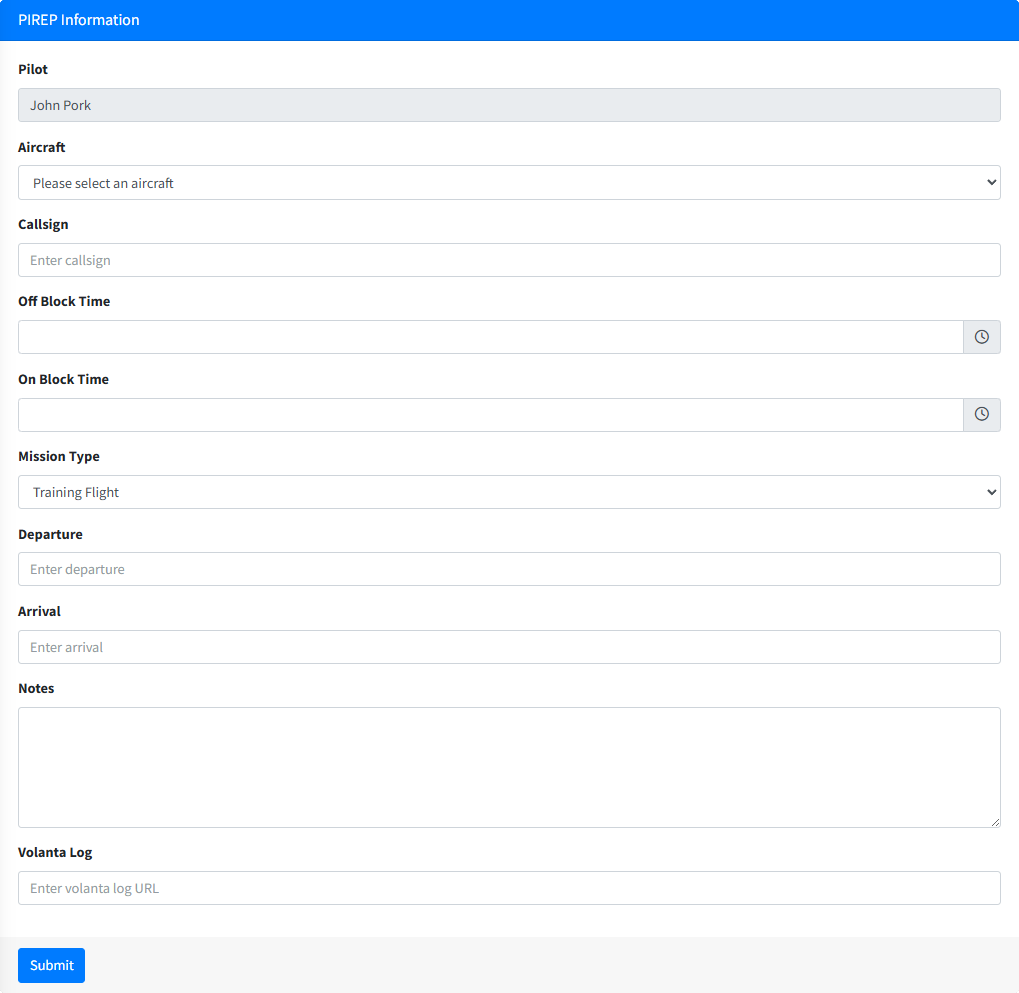
Once submitted, some PIREPS are to be manually reviewed by an Operations Administrator before they're approved, whilst some will be approved automatically. There is a set of parameters that if met, will require the PIREP to be manually reviewed, those parameters are as follows;
Flights over 3 hours
Flights that are over 3 hours long are manually reviewed to ensure that the filed flight time has not been entered incorrectly & to ensure that proper procedure has been maintained throughout the flight.
Training Flights (Under Instruction)
Training flights under instruction are to be manually reviewed to verify that the training has been completed in accordance with published MODv training material & that the exercise has been flown correctly.
Repositioning/Landaway Flights
Repositioning flights are to be manually reviewed to ensure that MODv aircraft are not being flown into areas deemed inappropriate by the administrative team.